
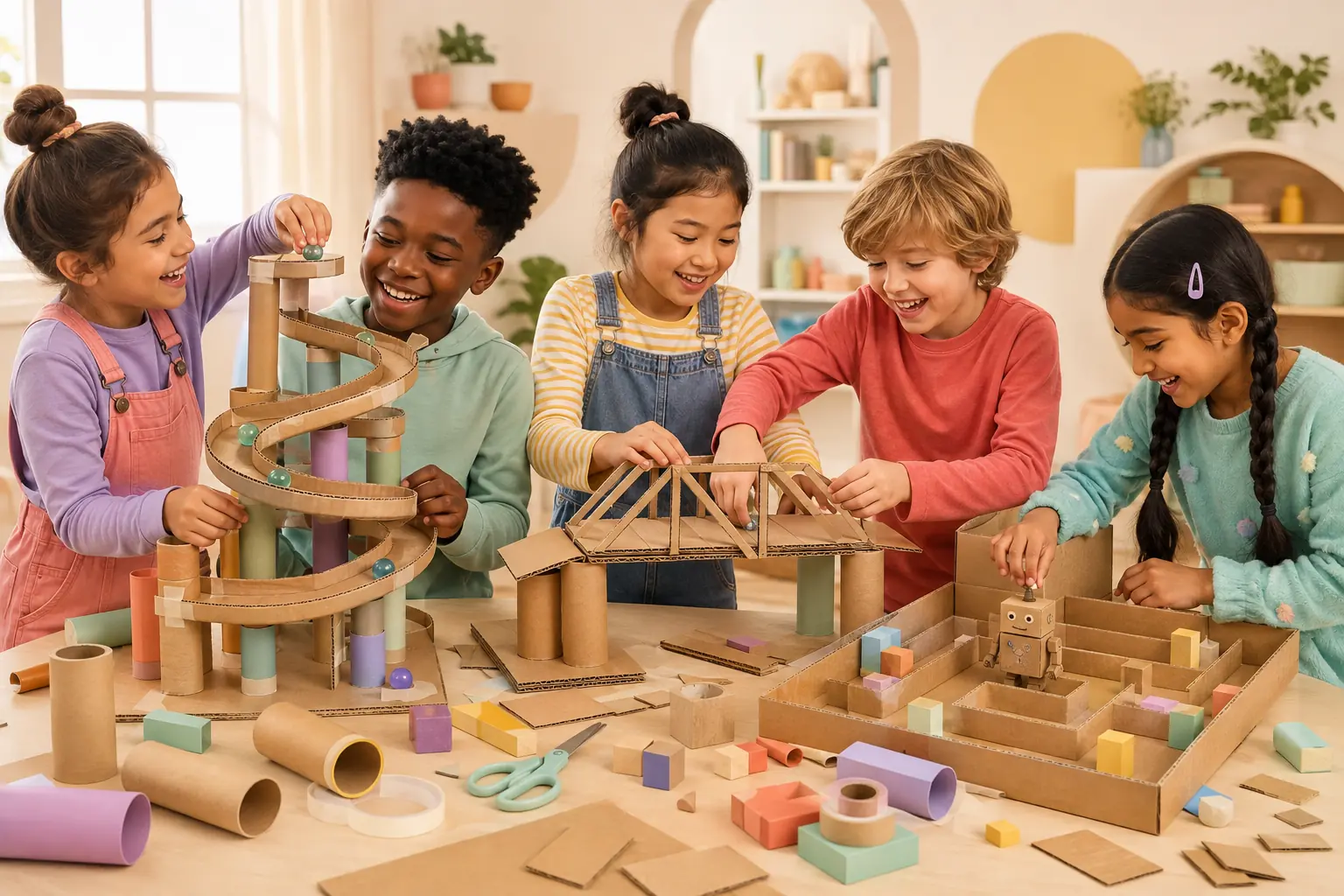
The tiny engineering loop
Every challenge follows the same four moves: imagine a solution, build a first version, test it against one clear goal, and change one thing. The redesign is where much of the learning happens, so celebrate the wobble, jam, or crash that gives the next clue.
Build a paper bridge
Span two stacks of books with one piece of cardboard. How many toy animals can it hold?
Upgrade: fold, curve, roll, or layer the cardboard—but keep the same span.
Make a slow marble run
Tape tubes and channels to a large box so a ball travels from top to bottom.
Upgrade: make the trip last five seconds longer without stopping the ball.
Design a robot delivery maze
Create streets, tunnels, and a loading dock for a coding robot—or move a paper “robot” one square per command.
Upgrade: add a detour and rewrite the route.
Build the tallest stable tower
Use ten cardboard pieces and 30 centimeters of tape. The tower must stand for ten seconds.
Upgrade: place a paper cup on top.
Create a zip-line carrier
Run string downhill between two sturdy points. Build a carrier that delivers a small toy passenger.
Upgrade: add a way to keep the passenger upright.
Invent a cardboard claw
Make a hand tool that can pick up a paper cup without your fingers touching the cup.
Upgrade: retrieve objects of three different sizes.
Build a wind-powered car
Add a paper sail to a lightweight cardboard vehicle and move it with a fan or your breath.
Upgrade: compare two sail shapes over the same distance.
Float a foil-and-cardboard cargo boat
Build a small vessel for a basin of water and count how many coins it can carry.
Upgrade: change the hull shape and test again. Keep cardboard edges dry where possible.
Make a shadow theater mechanism
Build cardboard sliders that move paper characters behind a screen without showing the operator’s hands.
Upgrade: make two characters move differently with one pull.
Protect an egg—or a toy stand-in
Design cardboard packaging that protects a plastic egg or small block from a short drop.
Upgrade: use less material while keeping the object safe.
Build a pinball pathway
Use folded rails and obstacles on a tilted box lid. Guide a large wooden ball into a target cup.
Upgrade: add two scoring zones with different difficulty.
Invent challenge thirteen
Pick a problem in the playroom: carry, sort, protect, launch, roll, lift, or connect something.
Upgrade: draw the plan, name the invention, and teach another child how to test it.
Questions that keep the child in charge
- What do you think will happen before we test it?
- Where is the force going?
- Which part bent, slipped, or jammed first?
- What is one change we can make without changing everything?
- How will we know whether version two is better?
Adapt by age
| Age | Adult role | Useful goal |
|---|---|---|
| 4–5 | Cut parts; model one connection | Roll, balance, stack, and describe |
| 6–8 | Help set one measurable rule | Predict, test, count, and compare |
| 9–12 | Ask for evidence; avoid fixing | Control variables, measure, and document redesigns |
Safety setup
An adult should use utility knives and make difficult cuts through thick cardboard. Supervise age-appropriate scissors and hot glue; lower-temperature glue still burns. Marbles, coins, rubber bands, magnets, batteries, and many craft pieces are choking or ingestion hazards for young children. Use larger substitutes and closed storage in mixed-age homes. Keep string activities supervised and never place loops around the neck.