
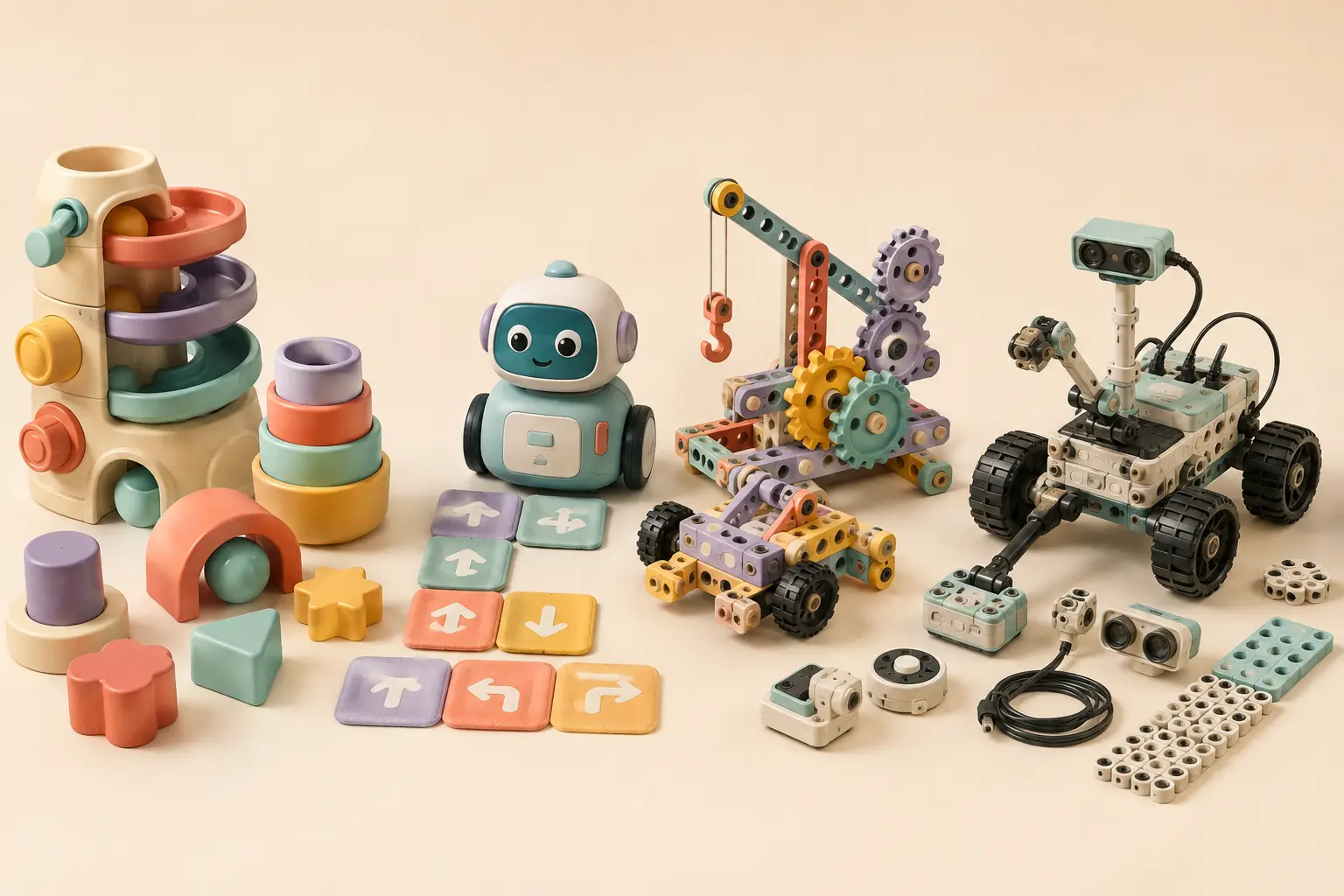
What makes a STEM toy age-appropriate?
The age on the box matters, especially when it reflects small-parts testing or a choking warning. But developmental fit needs a second look. Ask whether the child can understand the goal, physically manage the pieces, recover from a mistake, and play without an adult doing most of the interesting work.
The American Academy of Pediatrics recommends toys that match a child’s current abilities while encouraging new skills. It also emphasizes hands-on, social, and imaginative play. A motor, microphone, or app does not automatically make a toy educational; the child should still be deciding, building, predicting, testing, or explaining.
| Stage | Look for | Avoid as the main experience | Typical parent role |
|---|---|---|---|
| Ages 3–4 | Large pieces, matching, movement, pretend stories | Reading-heavy instructions and tiny construction parts | Model one idea, then play together |
| Ages 5–6 | Directional commands, short sequences, visible outcomes | Long setup before the first success | Start the first challenge and ask questions |
| Ages 7–9 | Block coding, sensors, modular builds, creative goals | One-trick toys with no progression | Help with setup, then step back |
| Ages 10–12 | Open projects, debugging, Python pathway, expansion | Closed activities they will finish in one afternoon | Support planning and safe tool use |
Big pieces and instant cause-and-effect
For preschoolers, “STEM” can be as simple as predicting where a ball will roll, matching a shape, building a stable tower, or giving a character one direction at a time. Look for sturdy controls, short play cycles, and room for pretend stories.
Good starting types: large gears, ramps, magnetic building with age-appropriate pieces, simple audio learning, and beginner coding characters designed for preschool use. Coding Critters can connect directional play with an animal story for children who meet the manufacturer’s age guidance.
Plan, run, notice, fix
This is a strong stage for screen-free coding. Children can place or enter several commands, predict a route, watch the result, and change the sequence. That cycle is early debugging—even when no code appears on a screen.
Botley 2.0 is designed for ages five and up and uses a handheld programmer, coding cards, obstacles, and longer sequences. Kids First Coding & Robotics is a better fit for children who enjoy stories and building models.
Combine coding with a real creative goal
Children in this range often need more than “make the robot move.” Look for mazes, music, drawing, sensors, storytelling, or a build they can modify. The goal should make the code meaningful.
Wonder Workshop Dash offers a ready-to-use robot and an app-based progression. Artie Max turns code into drawings. PYXEL, recommended by its manufacturer for ages eight and up, provides a bridge from Blockly-style coding toward Python.
Choose a platform, not a finished trick
Older children benefit from hardware that supports multiple projects, sensors, debugging, and a path beyond the starter lessons. They may still prefer visual block coding at first; a good kit lets them progress without making text syntax the price of admission.
Makeblock mBot2 is designed for children as young as eight and supports block-based coding and Python, with expandable sensors and build forms. The tradeoff is more adult help during assembly and device setup.
See current Amazon listing ↗Three filters that matter more than “educational”
Can the child produce a satisfying result within roughly ten minutes, or will setup consume the whole first session?
Can they invent a new route, build, rule, story, or program after the included challenges are complete?
Will the child make most decisions, or will an adult spend every session repairing connections and translating instructions?
Safety in mixed-age homes
If a younger sibling shares the space, follow the strictest relevant warning. The U.S. Consumer Product Safety Commission notes that products intended for children under three cannot present a small-parts choking, aspiration, or ingestion hazard. Store older-child construction pieces, batteries, cables, and detachable sensors in a lidded bin between sessions.