
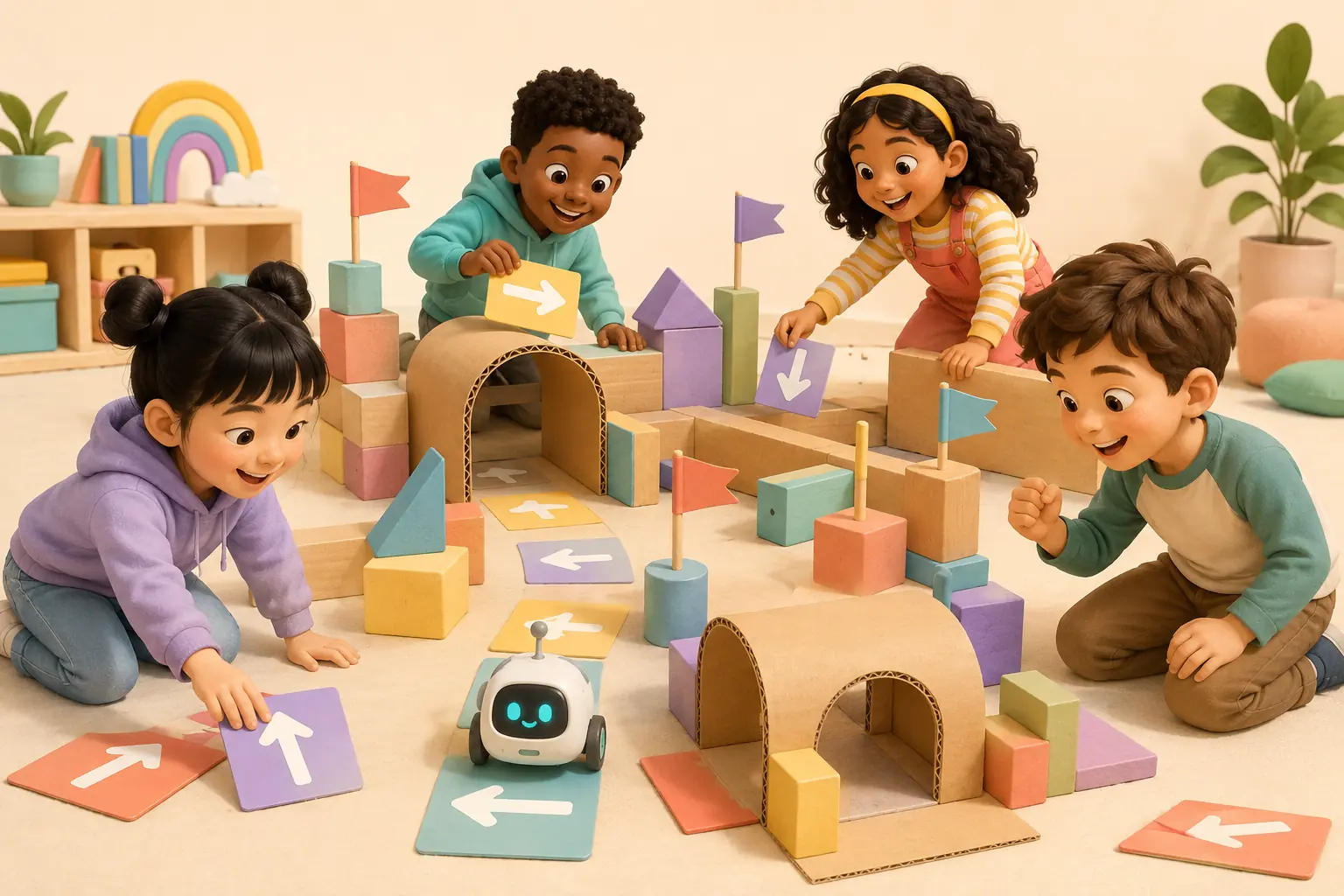
No robot? No problem.
Draw a face on a paper cup or small cardboard box. One person moves the “robot” exactly one square for each command. You can also let a player be the robot—just clear the floor first.
Mission supplies
Use what you already have: paper arrows, painter’s tape, cardboard, cups, blocks large enough for your household, crayons, and a favorite small toy to serve as the mission prize. Keep walking paths clear and follow the age and small-parts guidance for every item.
The snack delivery
Build a route from the “kitchen” to a stuffed-animal picnic. Program forward, left, and right commands. If the robot misses the picnic, change only one command and try again.
Skills: sequencing • spatial language • debuggingTreasure-map rescue
Hide a paper star at the end of a taped grid. One player writes the route; another tests it without seeing the treasure. Add a blocked square after the first run.
Skills: planning • communication • flexible thinkingCardboard tunnel town
Create tunnels, bridges, and buildings from boxes. Measure which openings are wide enough, then make a route that visits the library, park, and rocket station.
Skills: engineering • measurement • iterationThe dance algorithm
Invent four moves—turn, wiggle, beep, and pause. Arrange command cards into a dance, repeat the sequence twice, then challenge someone else to perform the same algorithm.
Skills: patterns • loops • creative expressionColor-code challenge
Assign an action to each colored paper: mint means turn, coral means stop, yellow means celebrate. Place the colors along a path and predict the final routine.
Skills: symbols • rules • predictionRobot zookeeper
Place animal drawings around the room. Program a safe feeding route, but add a rule: if the robot reaches water, it must turn around. Older kids can write the rule as “if/then.”
Skills: conditions • storytelling • route designThe great debug relay
A grown-up secretly changes one command in a working route. Players take turns predicting where the bug is, testing one change, and explaining the evidence.
Skills: debugging • teamwork • explaining reasoningInvent mission eight
Choose a character, a destination, one obstacle, and one surprise rule. Draw the map and teach the mission to someone else.
Skills: design • communication • open-ended playMake each mission fit the child
Use three commands, larger spaces, picture arrows, and no timer. Let the child move each card as the robot travels.
Add loops, a limited number of cards, measurement, points, or an “if the path is blocked” rule.
Give one child the map and another the robot. They must describe the route without touching each other’s materials.
Questions that build coding thinking
- What do you predict will happen first?
- Where did the route stop matching your plan?
- What is the smallest change that could fix it?
- Which steps repeat, and how could we make a loop?
- Can you explain the rule to someone who has never played?
Why this counts as coding practice
Coding begins before syntax. Children are decomposing a problem into steps, representing actions with symbols, predicting an outcome, testing, and revising. The American Academy of Pediatrics emphasizes that play supports problem-solving, language, social interaction, and healthy development. A robot can add feedback and delight, but the child’s thinking is the engine.