
Start with the child’s job
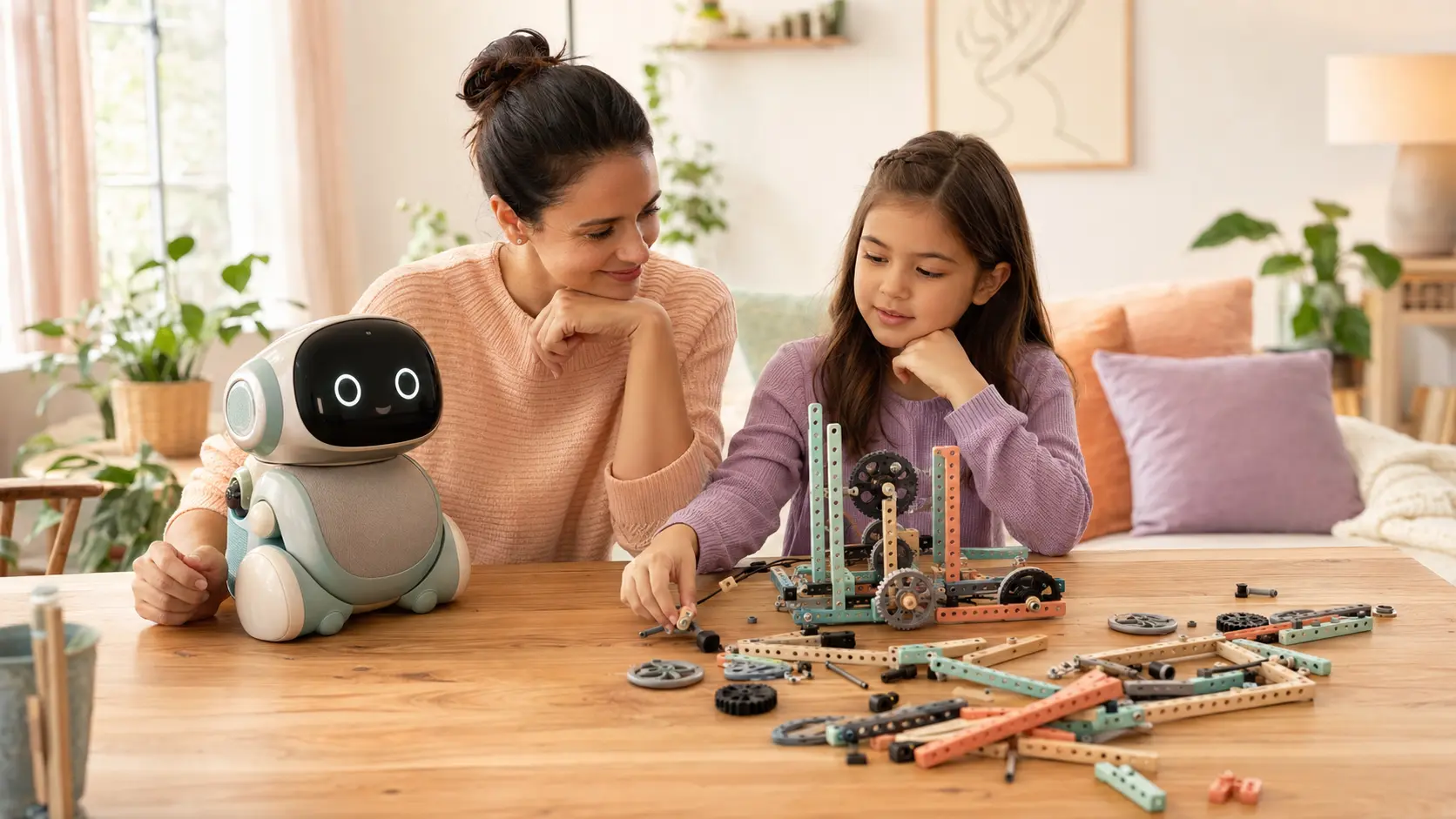
A toy’s learning value depends more on what the child does than what the device can do. If the robot performs impressive actions while the child watches, the technology may be entertaining without creating much practice. If the child must design a route, test a structure, explain a result, or revise a plan, the play is more active.
| Question | AI toy advantage | Traditional STEM advantage |
|---|---|---|
| What starts the play? | Conversation, personality, movement, prompts | A building challenge, materials, experiment, or puzzle |
| What does the child practice? | Question asking, language, responsive interaction, technology literacy | Planning, construction, spatial reasoning, troubleshooting |
| Privacy burden | Can include accounts, microphones, cameras, apps, and cloud services | Often low or none |
| Long-term resilience | Features can change with updates or subscriptions | Physical parts usually keep working without a service |
| Replay style | New prompts, content, reactions, or software features | New builds, rules, experiments, and child-created challenges |
When an AI toy is the stronger choice
An AI toy can be useful when a child responds strongly to character and conversation. A compact robot such as Miko Mini may encourage questions, movement, voice interaction, and guided activities. A mobile robot pet such as Loona emphasizes expression and novelty. Those qualities can help a hesitant child begin—but parents should still guide the session and verify claims or answers together.
- Your child loves characters and social play.
- Voice prompts make them more willing to practice.
- You are comfortable managing an adult account and privacy settings.
- You accept that some content or features may require Wi-Fi or a subscription.
When a traditional STEM kit is the stronger choice
Traditional kits are usually better when the learning goal is construction, measurement, mechanical reasoning, debugging a physical system, or open-ended invention. A screen-free coding robot such as Botley 2.0 sits between the categories: it has electronics and programmed behavior, but no app, camera, child account, or open-ended voice AI.
- Your child enjoys taking things apart, building, drawing routes, or solving puzzles.
- You want a toy that still works without internet service.
- You prefer low privacy risk and predictable ongoing cost.
- You want siblings or friends to collaborate around physical pieces.
What about screen time?
“Screen-free,” “offline,” and “no child-facing screen” are not the same. A robot may require a parent’s app for setup while the child mainly interacts physically. An audio player may have no traditional screen but still need Wi-Fi to download content. A coding robot may use a tablet as a creative programming tool rather than passive video.
Judge the role of the screen: is the child creating and testing, or mainly consuming? Then decide whether that role fits your family’s media plan.
Total cost is more than the box price
For an AI toy, include subscriptions, app purchases, accessories, and the risk that an important cloud feature changes. For a traditional kit, include replacement consumables, expansion packs, batteries, and whether many pieces are likely to disappear. A durable offline kit may have higher upfront cost but lower ongoing dependence.
A balanced approach often works best
Families do not need to choose one category forever. A child might use an AI robot for a short question-and-movement session, then use blocks, paper, or craft supplies to build something inspired by the conversation. Technology becomes the prompt, while the child still performs the deeper creative work.
Try the 20-minute transfer test
- Let the toy introduce a problem, story, or challenge.
- Move away from the device.
- Ask the child to draw, build, act out, or explain a related idea.
- Have the child show what changed after testing.
Our recommendation
For a first purchase, choose the simplest product that supports the skill you actually want. Do not pay for a camera, cloud AI, or subscription if your goal is sequencing. Do not buy a large construction kit if your child is motivated mainly by conversation and character. The best technology is the least complicated tool that keeps the child actively thinking.